Dr. Rebecca Hains
Author, professor and speaker | Children's media culture, media literacy, and media criticism

Cartoonists and animation experts weigh in: the new Merida doesn’t HAVE to look this way
In the past few days, the new Merida designed for the Disney Consumer Products Division has lead to heated controversy.
On the one hand, critics argue that the redesign undercuts Merida’s strength, serving her up in a more stereotypical princess form. Meanwhile, their detractors argue that “it’s not that bad,” that they “can’t see the difference,” that the critics are “overreacting,” or that the redesign “HAD to happen this way.”
In this post, I’d like to address that last point: the argument that the redesign HAD to happen this way. The core argument is that Merida must look different in the Disney Princess line because she’s drawn in 2D, rather than as a CGI image–so her image must change in translation, by necessity.
Let’s see what the animation and cartoon experts have to say on that point.
First, let’s begin with cartoonist Matthew Bogart’s take on that argument. He writes:
Character design matters.
If there’s one thing the character design class I took in college stressed more than anything else it’s that a good character design informs the viewer who the character is, what they are like. What they wear, how they stand, how they do their hair, the shape of their face, their standard expressions, what they carry with them, these are all vital decisions in a good design.
If these are all vital decisions in a good design, then what’s going on? Why has Disney’s Consumer Products Division changed what Merida wears, how she stands, how she does her hair, the shape of her face, her standard expressions, and so on?
Bogart explains that the changes found in redesign are not about the translation from 2D to CGI; rather, it’s a deliberate effort to make Merida fit the passive, pretty princess trope that dominates the Disney Princess line.
When you market a character you have to boil them down to their essential elements. […] [Merida] was depicted in trailers and posters as strong, determined, adventurous, beautiful, and heroic.
This redesign de-emphasizes those qualities and pushes for a Merida that is more glamorous, sassy, and passive.
In other words, Bogart writes, Disney’s Consumer Products Division is
taking the established Merida design from the film and re-imagining her to more closely resemble the typical damsel in distress that the Disney princess line seems to champion.
Ouch.
Animation expert Charles Kenny has also analyzed the redesign on his blog, the Animation Anomaly, and reaches a similar conclusion. Dispelling the idea that the redesign had to happen in this way, he writes:
We all know that multitudes of artists work on these characters and the very nature of merchandise (with all its differing surfaces and sizes) necessitates changes to permit an acceptable level of familiarity across the range.
Well, normally it isn’t a problem because the characters remain relatively consistent. In Merida’s case, however, the change is near radical. […] Merida’s case stands out [because] she’s undergone not so much a redesign but a transformation. Even by comparing her looks (and her measurements) one can deduce that she isn’t likely to exhibit the same character traits as her CGI original.
What character traits does Charles Kenny mean? Well, we can glance back at Matthew Bogart’s post for a quick run-down: “a beautiful, rough and tumble, scottish adventurer who was technically a princess but rebelled against the frill, pomp, and sexism that came with her post.”
Therefore, Kenny reminds his readers:
We’re long, long past the time when merchandise had to look different on account of manufacturing technology and the like. Today, it’s possible to maintain a high degree of quality across the board. There really is no reason why a Merida doll has a different structure to her animated counterpart, or for that matter for a stock image of her on a T-shirt requires a redesign.
Heck, even the Disney Princesses themselves do not need such a standardised sense of design. What it amounts to is the merchandising or marketing division of the corporation attempting to stamp their impression on characters created somewhere else (by animators). It amounts to overstepping their boundaries insofar as they may adapt characters to their work, but outright changing them is unconscionable.
In sum, the argument that Merida HAD to be changed this way is patently untrue.
Since a picture is worth a thousand words, let’s leave the final words with a few cartoonists who have tackled the matter visually.
Matthew Bogart concluded his post by applying Merida’s redesign to Batman, showing just how much the design of her new pose, outfit, and face shape should be understood to alter her character:

David William Trumble illustrated what would happen if Disney redesigned other strong women, such as Hillary Rodham Clinton, Rosa Parks, Marie Curie, Malala Yousafzai, and Ruth Bader Ginsberg (click here for a slideshow with individual explanations):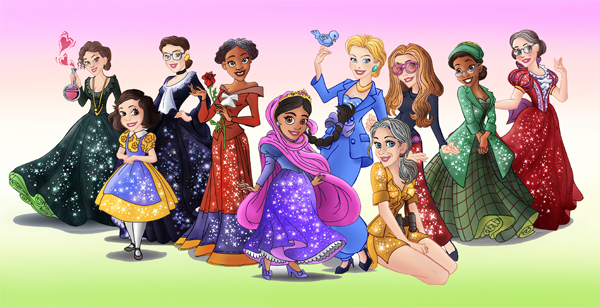
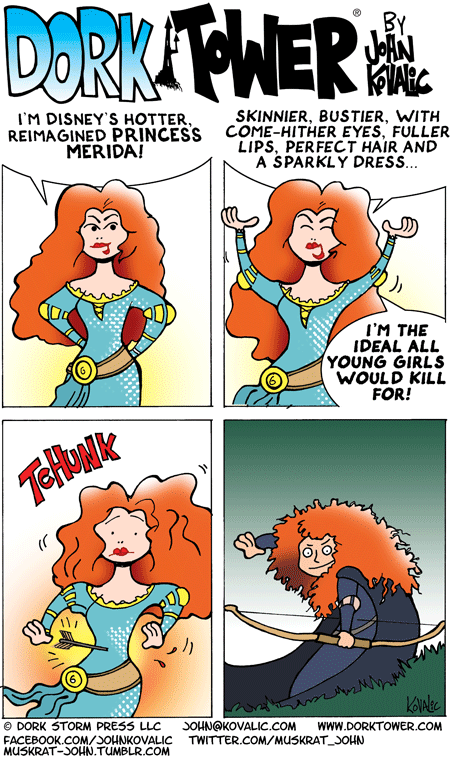
And John Kovalic of the “Dork Tower” comic offered this gem:
——
To read my previous posts on Merida, click here.
To read my previous posts on the Disney Princess brand, click here.
——
Do you like this post? Follow Rebecca Hains on facebook or twitter.
About the author: Rebecca Hains, Ph.D. is an associate professor of communications at Salem State University, where she teaches advertising and media studies. Her new book, Confronting Cinderella: Guiding Our Girls Through the Princess-Obsessed Years, will be released by Source Books next year.
Disney faces backlash over new “sexy” Merida; pulls new image from web site as a result
UPDATE, May 16, 2013: Disney has stated that 1. the 2D image was never on their official web site in the first place (though, oddly, it’s all over the official Australia/NZ version of the Disney Princess site–which may have been the source of any confusion), and 2. they will not be retracting the new Merida.
Click here for my new post, in which I argue they missed the whole point of the petition. Clearly, we still have work to do.
——–
On Saturday, Disney held a “coronation ceremony”(1) for Merida, star of the Disney-Pixar film Brave. In the coronation, Merida officially became part of the Disney Princess lineup. This means that her image has been added to the 2D collection of princesses in a cartoon form that fits stylistically with that of her princess peers.
Unfortunately for Disney, the new cartoon image of Merida that Disney created for the lineup overshadowed all conversation online about the coronation. The reason? The new cartoon sexualizes Merida.
That’s right: Although Merida was created by a woman as a role model for girls, the male-dominated consumer product division at Disney has ignored the character’s intended benefits for young girls, sexualizing her for profit. 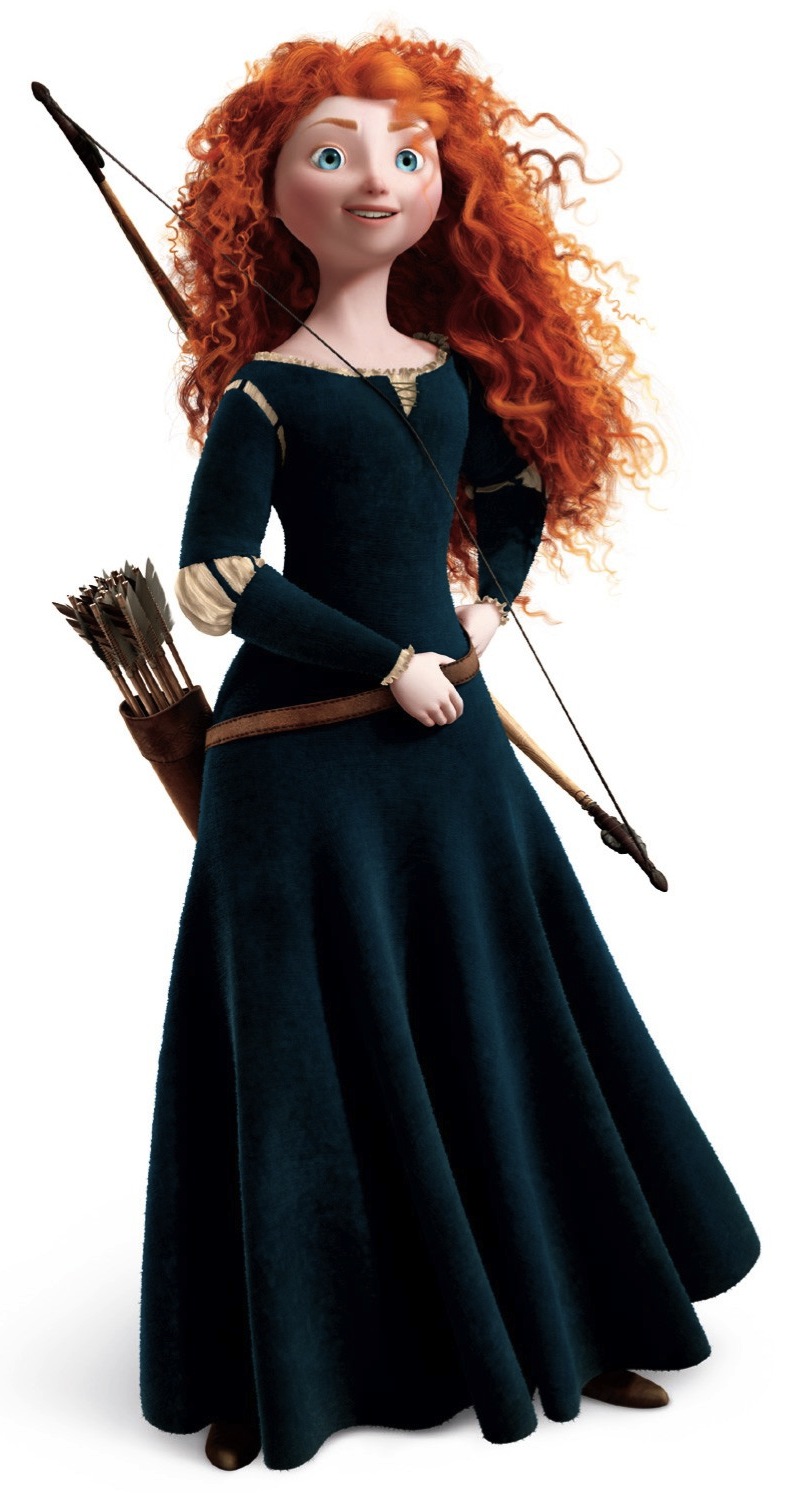
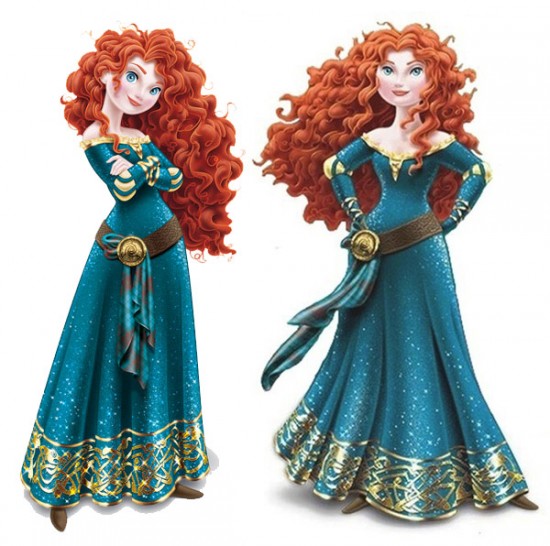
Compared with her film counterpart, this new Merida is slimmer and bustier. She wears makeup, and her hair’s characteristic wildness is gone: It has been volumized and restyled with a texture more traditionally “pretty.” Furthermore, she is missing her signature bow, arrow, and quiver; instead, she wears a fashionable sash around her sparkly, off-the-shoulder gown. (As Peggy Orenstein noted when she broke the news of the redesign, “Moms tell me all the time that their preschool daughters are pitching fits and destroying their t-shirts because ‘princesses don’t cover their shoulders.'” I’ve heard the same from parents, as well.)
It doesn’t have to be this way. Some might argue that the changes to Merida are simply a result of her being rendered in 2D, but these are deliberate, calculated changes. She has been presented in 2D form in children’s books since before the movie was released, and she’s still looked like herself.
No–these changes to Merida’s appearance are significant. Sadly, they align with the American Psychological Association’s definition of sexualization, which says that sexualization occurs when any of the following four conditions are present:
- a person’s value comes only from his or her sexual appeal or behavior, to the exclusion of other characteristics;
- a person is held to a standard that equates physical attractiveness (narrowly defined) with being sexy;
- a person is sexually objectified — that is, made into a thing for others’ sexual use, rather than seen as a person with the capacity for independent action and decision making; and/or
- sexuality is inappropriately imposed upon a person.
Since Merida is beloved for breaking the princess mold, proving that a girl needn’t be stereotypically “girly” to be a princess, realigning Merida’s look to echo the other 10 Disney Princesses’ narrow range of appearances is a huge mistake.
The backlash from parents has been tremendous; a petition on Change.org already boasts more than 120,000 signatures. The petition explains:
The redesign of Merida in advance of her official induction to the Disney Princess collection does a tremendous disservice to the millions of children for whom Merida is an empowering role model who speaks to girls’ capacity to be change agents in the world rather than just trophies to be admired. Moreover, by making her skinnier, sexier and more mature in appearance, you are sending a message to girls that the original, realistic, teenage-appearing version of Merida is inferior; that for girls and women to have value — to be recognized as true princesses — they must conform to a narrow definition of beauty.
What’s more, Brenda Chapman–Merida’s creator–has gone on record voicing her outrage at this redesign. Chapman argued:
They have been handed an opportunity on a silver platter to give their consumers something of more substance and quality — THAT WILL STILL SELL — and they have a total disregard for it in the name of their narrow minded view of what will make money. I forget that Disney’s goal is to make money without concern for integrity. Silly me.
As of today, Disney has quietly pulled the 2D image of Merida from its website, replacing it with the original Pixar version. Perhaps we’ll be spared an onslaught of sexy Merida merchandise yet.
—–
If you haven’t yet signed the petition, you can do so at Change.org and at MoveOn.org.
—–
For further reading: To view more of my posts on Merida, click here. For more of my posts on the Disney Princess brand, click here.
—–
Do you like this post? Follow Rebecca Hains on facebook or twitter.
About the author: Rebecca Hains, Ph.D. is an associate professor of communications at Salem State University, where she teaches advertising and media studies. Her new book, Confronting Cinderella: Guiding Our Girls Through the Princess-Obsessed Years, will be released by Source Books next year.
—–
(1) Disney holds “coronation ceremonies” for its princesses about a year after a film’s release–a great way of bumping up interest in a princess after her film’s momentum has died down.
More on teaching boys not to rape
The Christian Science Monitor picked up my post on teaching boys to understand “consent” and “respect” from an early age. Here’s the link:
Meanwhile, folks have been sending me links to other new posts on the same topic. Check these out:
- “Prevent another Steubenville: What all mothers must do for their sons” by Kim Simon
- “A letter to my sons about stopping rape” by Magda Pescenye
These links give me hope: Even though Zerlina Maxwell has been bashed and threatened for arguing that men must be responsible for stopping rapes, I believe she’s right–and clearly, other moms do, too. In the aftermath of the Steubenville rape trial, we mothers of boys have an opportunity: We can help shift the cultural conversation about stopping rape. Instead of asking, “How can girls avoid being raped?”–which too often involves victim-blaming–let’s keep asking, “How can boys not rape?”
The answer to that latter question is more dynamic, as it involves confronting rape culture head-on. It has the power to change the status quo.
The sad story of Princess Leira: a retelling of a well-known tale
I’m going to tell you a story you already know. (Tell me when you recognize it.)
——-
Leira is a princess of a magical kingdom on Earth–a beautiful, shimmering land of lush forests and colorful meadows near a picturesque mountain range.
The subjects of Leira’s kingdom include other people, like herself, as well as many amazing, brilliant woodland creatures who are full members of her society. The woodland creatures even contribute to its art and culture. They are painters, musicians, writers.
Unfortunately, Leira’s kingdom is at risk. A race of space aliens have begun using their advanced technology to harvest her subjects for food: Every so often, they hover in the sky above and use electromagnetic beams to capture the woodland creatures, which they devour. Woodland creatures who ascend the mountain seem to be at the greatest risk: the aliens tend to harvest their prey at higher altitudes.
The space aliens have not yet captured any of Leira’s fellow human beings, but her parents, the king and queen, fear it is only a matter of time. They decree that everyone must stay away from the mountains.
But Leira cannot resist those mountains. Sometimes, debris from the space aliens may be found there. She loves their debris. It gleams and has strange, hard edges, unlike anything she’s ever seen. Leira marvels at the remnants of their technology and wonders how each item is used. She becomes obsessed with collecting more of it, and begins putting herself at risk by ascending to higher and higher altitudes to do so.
With time, poor Leira begins descending into a Stockholm-syndrome-esque form of madness, in which she feels empathy with these vicious aliens who love to devour her kingdom’s citizens. Leira wants to leap on a cloud, travel through the stars, and see these fascinating alien creatures up close. What are they like? How do they spend their time? She sneaks away recklessly to the mountains with binoculars and telescopes, hoping to glimpse them without being seen.
One day, her madness reaches new heights: She would give anything to BE one of the aliens. Though it seems practically suicidal, she longs to abandon her position as the beautiful princess Leira and ascend to become a superior being. She would give up her identity and become one of them.
It’s a bad situation.
——
…And that is the whole premise of The Little Mermaid. Ariel wants to be “part of that world” that would literally gobble hers up. It would be interesting to see a sci-fi film version of the story. Kind of fun but strange to think about, right?
But… the Little Mermaid gave up her voice!
Ah, Ariel. I love many things about your movie, particularly the music. But as a character, you made such poor choices. Giving up your voice to get a man? That set a really poor example for girls. In a society that positions girls as weak, and often suggests their voices don’t count as much as male voices, girls need to see female characters they love who raise their voices. They need to be inspired to speak out.
For that reason, I find it odd that Disney is now describing The Little Mermaid as a classic that “gave voice to a whole generation”:
Did the film give a whole generation princess fever? Sure?
But did it give a whole generation a VOICE? No way.
I think it’s a really strange choice of words. Readers: What’s your take on this one?
Kids’ products and gender: What’s on the packaging?
Preschoolers can be quick to notice gendered illustrations on products. If a package has a picture of a boy on it, that item must be for boys; if it has a picture of a girl on it, it must be for girls. Likewise, if a package has pink, flowers, and/or hearts, it must be a girl’s product; if it has cars, trucks, or construction vehicles, it must be for boys.
I saw this in action this weekend, when we took our four-and-a-half year old son, T., shopping for a new bicycle helmet.
His favorite colors are blue, red, green, and purple; so to avoid buying a helmet covered in licensed characters (we do not need one more Lightning McQueen anything!), I offered him a few choices: A black helmet with blue and green stripes; a solid red helmet; and a solid dark purple helmet.
For a moment, I thought he was going to choose the purple helmet. But then, he announced: “No, mama, that one’s for girls.”
It looked pretty gender-neutral to me, so I was puzzled. “What makes you think it’s for girls?” I asked.
“From the picture, mama. See? That’s a girl.”
I took a closer look, and sure enough, the helmet–though labeled a “youth” helment–showcased a photo of a smiling girl with a long ponytail and a pink shirt.
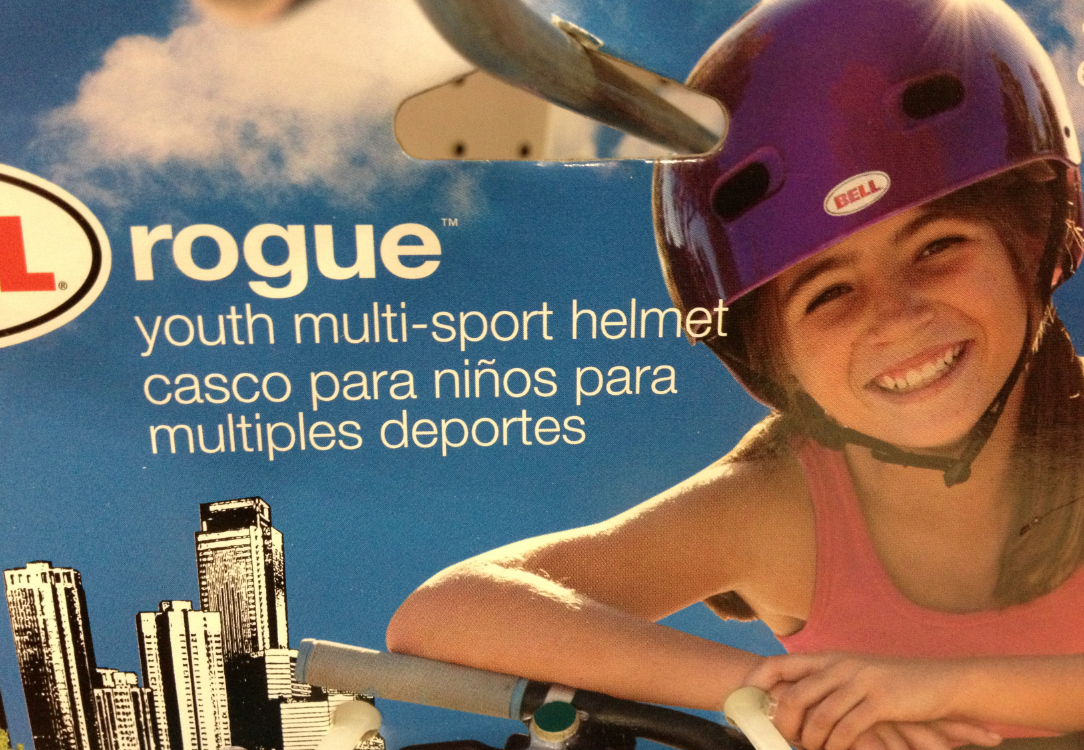
Other helmets either had photos of boys or girls on them, or did not feature a photo at all. I realized that any helmet that was remotely girlish–with even the smallest touch of pink or purple–had a girl on the packaging; those that seemed boyish or gender-neutral (e.g., black and white) only depicted boys.
After much deliberation, my son chose the blue and green helmet. It did not have a photo of a child on it, but its colors clearly coded it as appropriate for boys–and it had flashing lights on the back! No way could any other helmet compete with that.
Before he made his choice, I explained something to him: “Just so you know, the purple helmet is for boys AND girls,” I said. “Purple is not just for boys or just for girls. Colors are for everyone!”
“Hm. Okay, mama.”
Phew. So far, he seems pretty open to this concept. I saw this in action a few months ago, when my son was shopping for Hot Wheels cars to go with his T-Rex Takedown set.
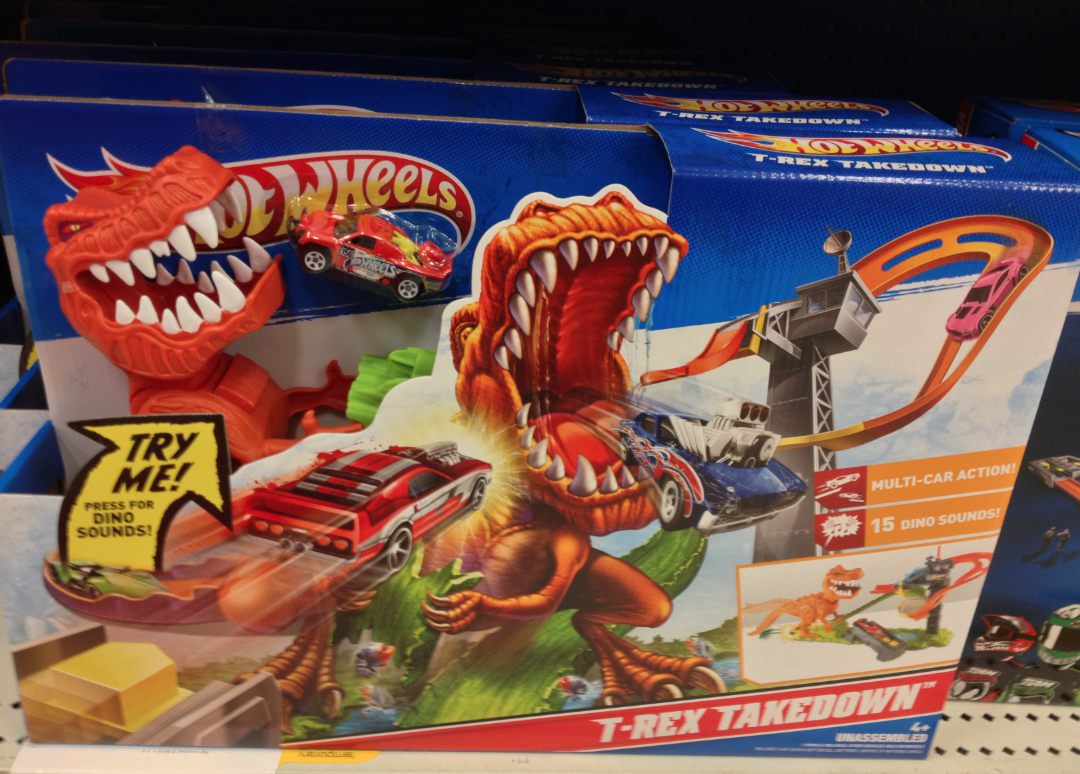
He decided that he wanted a blue car, a green car…and a pink car. I was thrilled! But then I was disappointed: there was not a single pink Hot Wheels car in the store.
“I’m sorry we can’t find a pink car,” I said. “I’ll try to find you one at another store.”
“Okay,” T. replied, “because I really want one. It really really needs a pink car!”
I went home and posted about it on facebook, and within minutes, friends and family were helping me with my search. My mom came through; she found a pink car in her local store. My son was thrilled.
Only later did I think to ask: Why did he need a pink car, anyway?
His answer: “Because it shows it on the box!”
Oh!
I took a closer look, and sure enough, he’d noticed something that I had entirely missed: in the upper right-hand corner, a pink Hot Wheels car was careening down the tracks.
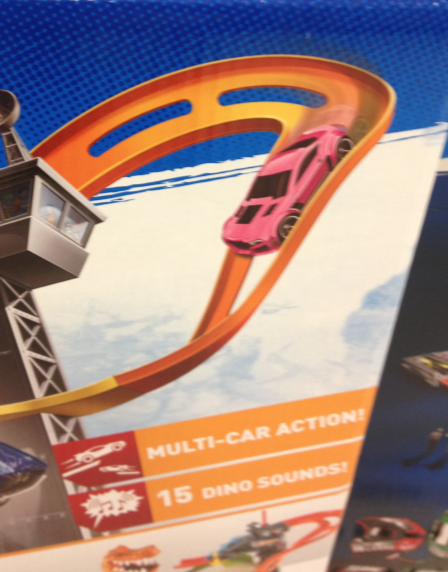
I hadn’t picked up on this small detail at all, but for my son, it was significant enough to make him request a color other than one of his favorites. Amazing!
I’m sure that detail isn’t lost on other children, either. In fact, the inclusion of a pink car on the package might help make girls feel that this toy–though stereotypically boyish–is for them, too. And I think that’s really great.
What if the purple helmet had a photo of both a boy and a girl on the packaging? Maybe my son would have selected it. Maybe the manufacturer would be able to sell that model to twice as many kids!
But unfortunately, that’s not how marketing usually works nowadays. It’s all about segmentation, about separating the boys from the girls, in hopes of selling twice as many products. The logic seems to be that if a product is just for girls, it won’t be handed down to their baby brothers, and vice-versa–so segregation and segmentation is seen as good for business.
That’s a shame, since it’s important for boys and girls to learn to play together. In too many cases, marketers are shortchanging our kids. The T-Rex Takedown packaging is the exception, not the norm.
In sum, packaging is important. The way manufacturers label things matters. It plays a role in the socialization of our kids. It’s worth paying attention to it, so that you can talk about it with your children when you need to: I’m guessing that your kids, like mine, have already noticed.
Parents: Have you seen any interesting examples of gendering on packaging, whether stereotypical or defying stereotypes? How have your kids responded to them? I’d love to know.
—
Do you enjoy this blog? Please follow me on facebook or twitter. Thank you!
I haven’t been blogging much lately. My reason?Introducing
I haven’t been blogging much lately.
My reason?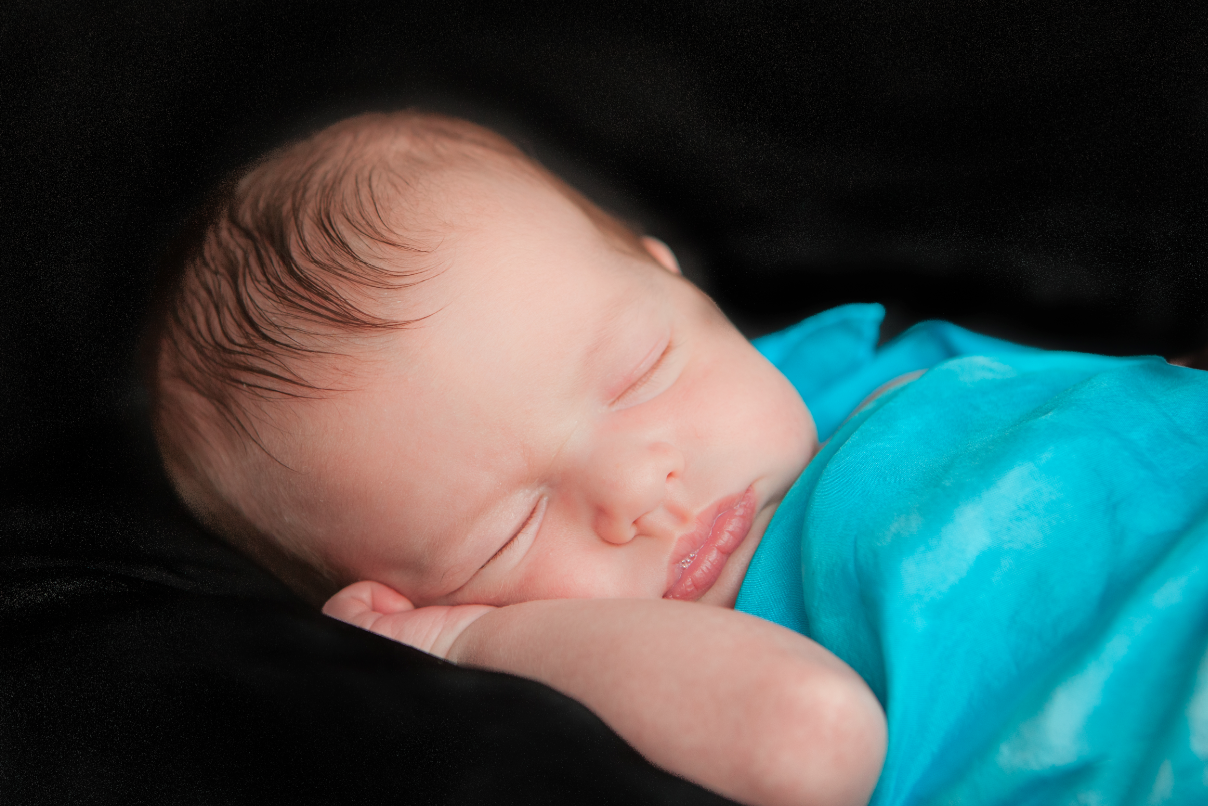 Introducing our new baby! He was born on Halloween, which means there should be some fun costume-themed birthday parties in our future. 🙂
T. is a doting big brother; he thinks our baby is “soooo cuuuute” and pretty much can’t stop kissing him. (I think he’s 100% right, of course!)
—-
I’ve got a couple of new posts in the works–but for now, I want to share a bizarre product with you: Disney Princess Hair Extensions.
Unlike the Disney Princess Burpee seeds, which feature a normal product in a licensed package, these hair extensions are kind of surreal. They feature pictures of the princesses printed ON THE HAIR ITSELF! They’re like tattoos your for daughter’s hair.
I’m almost entranced by their tackiness.
“Rapunzel, Rapunzel, let down your tattoo-sleeved-hair to me!”
So strange.
Has anyone seen a stranger Disney Princess licensed product out there? If so, please share–I have to hear about it!
—-
Networks: When viewers attack the women on your newscasts, let the women speak up.
A few weeks ago, meteorologist Rhonda Lee offered a passionate response via social media to a viewer’s complaint about her hair. The complaint read:
“the black lady that does the news is a very nice lady.the only thing is she needs to wear a wig or grow some more hair. im not sure if she is a cancer patient. but still its not something myself that i think looks good on tv. what about letting someone a male have waist long hair do the news.what about that.”
In response to this instance of sexism and racism, Lee explained how her hair grows* and that she takes pride in her heritage. Explaining that she deliberately chose her short haircut, she wrote,
Many Black women use strong straightening agents in order to achieve a more European grade of hair and that is their choice. However in my case I don’t find it necessary. I’m very proud of who I am and the standard of beauty I display. Women come in all shapes, sizes, nationalities, and levels of beauty. Showing little girls that being comfortable in the skin and HAIR God gave me is my contribution to society.
Now, a few weeks ago, anchor Jennifer Livingston was also picked on by a viewer — in her case, about her weight. Just as Lee responded to her critic on facebook, Livingston responded on the air, saying, “To all of the children out there who feel lost, who are struggling with your weight, with the color of your skin, your sexual preference, your disability, even the acne on your face, listen to me right now. do not let your self-worth be defined by bullies.”Livingston was hailed in nationwide reports as a hero for her public broadcast. Sadly, Lee was not; her network actually fired her for her social media response.
How unjust for Lee, and what a huge opportunity missed by the network. Had they played their cards differently, they might have been able to build upon Lee’s comments and raise awareness of the need for diverse role models on television. Girls deserve better than cookie-cutter women all over the screen; they should be seeing women of many shapes and sizes, of many races and ethnicities, and yes, with a range of hairstyles–not just those reflecting overly narrow white standards of beauty.
Furthermore, those women need to be allowed to use their voices. It’s common knowledge that women who appear in visual media are treated like specimens under a microscope; people scrutinize their appearances and are quick to judge them in harsh, unforgiving ways. Men like those who criticized Livingstone and Lee act with incredible privilege, assuming that all women should conform to a standard of beauty that is pleasing to their eyes–completely ignoring the women’s own subjectivity and individuality when they make statements like these:
it’s still not something myself that I think looks good on tv.
As I explained in my book, young girls growing up in this society don’t just witness this kind of relentless criticism of women’s appearances; they learn to take part in it. Unfortunately, as they approach adolescence, they often turn that critical eye on themselves, with disastrous results to their self-esteem, because who can possibly measure up to our society’s impossibly rigid beauty ideals?
Girls won’t learn to fight back against this unrelenting gaze if they don’t have good role models who have demonstrated that it’s possible to do so. In other words, if Lee sees racist remarks posted about her to her KTBS-TV’s facebook page, and there is no community moderator willing or able to delete the original post for its offensive nature, she has the right to speak up for herself–just as Livingstone did on the air.
By answering their critics, women like Livingstone and Lee are doing very important work, speaking out not only for themselves, but for girls and women everywhere.
A change.org petition is circulating in hopes that KTBS-TV will give Lee her job back. In case you are interested in signing, the petition is here.
——
* Note that black women find themselves having to educate white people on the topic of their hair all too often. Lee shouldn’t have even had to explain herself, but to her credit she did so with graciousness.
Raising Media Literate Children: My Interview on Wisconsin Public Radio
Yesterday, I was a guest on “At Issue with Ben Merens” on Wisconsin Public Radio, an NPR member station. The topic: Raising media literate children. Here’s a brief description and a link to an MP3 recording of the show:
 It’s part-two of At Issue’s series on media literacy. This hour, Rob Ferrett’s guest has tips for raising media literate children among an ever-changing media landscape. Guest: Rebecca Hains, professor of advertising and media studies at Salem State University. She’s also a Modern Parenthood blogger at the Christian Science Monitor. https://rebeccahains.wordpress.com/
Listen now: MP3 file
Many thanks to Rob for the chance to talk about this important topic with him and his callers. I enjoyed it!
 Dr. Rebecca Hains
You must be logged in to post a comment.